Signed in as:
filler@godaddy.com

Welcome to the 55th annual NAMBA National Championships. Glad you stopped by.
Here's a quick rundown of how RC boat racing works — and how you can get in on it.

One of the most exciting parts of the NAMBA Nationals is the variety of boats you'll see on the water. Mono hulls feature a traditional V-bottom design, tunnel hulls ride on twin sponsons for maximum speed, and hydroplanes skim across the surface with only a few points touching the water. These boats are powered by either electric motors, nitro engines, or two-stroke gasoline engines, each creating its own unique style of racing.
Don't let their size fool you—these boats are incredibly fast. Depending on the class, speeds range from 50 mph to well over 85 mph. At top speed, the fastest boats can cross the length of a football field in a little over two seconds, demanding lightning-fast reflexes from their drivers.
You don't have to spend thousands of dollars to enjoy RC boat racing. Many racers get started with affordable ready-to-run boats for as little as $500, while experienced competitors may invest $800 to $3,000 or more in a National-level setup. The great thing about the hobby is that there are classes for nearly every budget and experience level.

This is where the Contest Director announces from. Look for the yellow buoy directly in front of the drivers stand in center of the course, this marks the start/finish line.
Each heat runs with boats in a specific class. There is a maximum of 7 boats on the water at once. Often there are several heats in each class.
The heat starts with a 2-minute count down. Drivers and pit-crew start and launch their boats.
At 0:30 to the start mill-time begins — no boat can enter the water after this point. Drivers jockey for position and time their run to the start line.
When the clock strikes zero, a boat must be on the right side of the start/finish line to be considered a good start. If a boat is over, it's a jump start and must complete an extra lap.
On a clean start, it's a race to complete six laps. First boat across the finish line wins the heat.
If a boat strikes a buoy or goes around it on the inside, the driver receives a one-lap penalty—called a Buoy Cut. If a boat crosses into another boat's lane without leaving enough space for the boat already in that lane, they will receive a lane infraction, which is also a one-lap penalty.
Points are awarded by finishing position in each heat:
1st - 400
2nd - 300
3rd - 225
4th - 169
5th - 127
6th - 96
7th - 72
DNF (Did not finish) - 25
DNS (Did not start) - 0
Each class has 4 rounds of heats throughout the day. At the end of the 4th round, the driver with the most points will be the race winner and 2026 National Champion in that class. In the event of a tie for one of the podium spots (1st, 2nd, or 3rd), a run-off heat will be run.
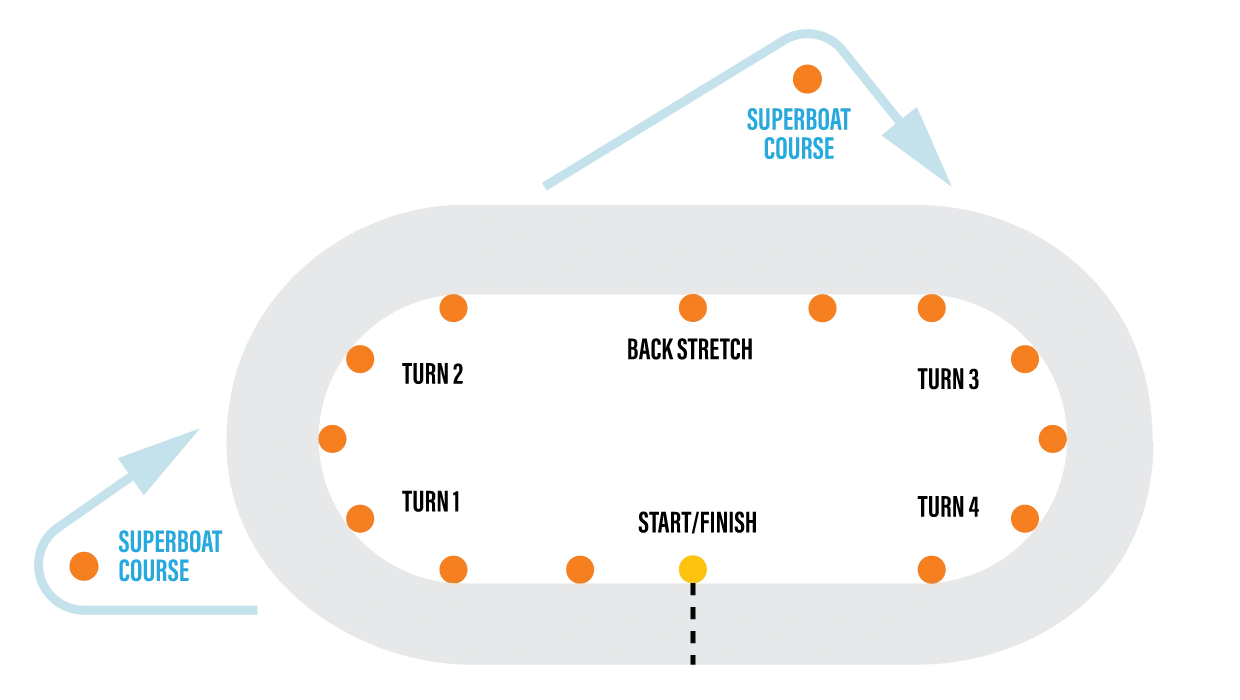
The 2026 NAMBA Nationals will be contested on an official 1/6-mile heat racing course. Each race consists of six laps, covering a total distance of one mile. Heat times begin when the race clock reaches :00 and end when the first-place boat completes its final lap, including any required penalty laps.
The Superboat class races on a larger tri-oval course that includes two additional buoys beyond the standard oval. Watch for the extra turns off Turn 1 and at the end of the backstretch entering Turn 3.
Most classes race clockwise around the course. The 1/10 Scale Unlimited Hydroplanes are the exception, racing counterclockwise on the standard 1/6-mile oval.